When we chose books for our three-year-old daughter, we wanted her to meet characters with possibilities: girls who asked questions, people from different backgrounds and families whose lives did not look exactly like ours. We wanted stories that left room for curiosity rather than deciding in advance who a child could become.
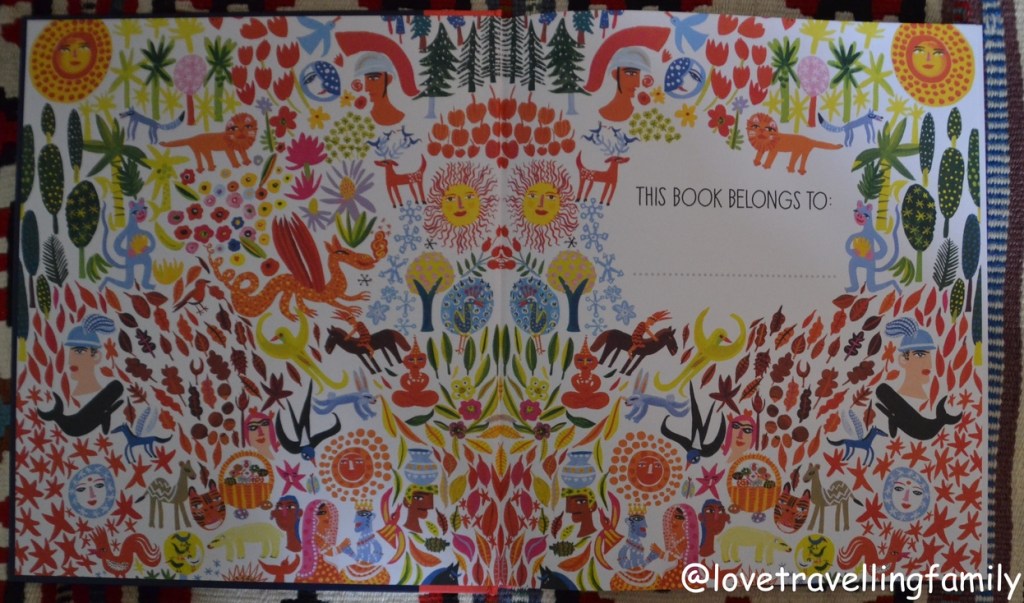
This is a selection from our shelves at the time. Some books invited a laugh or a close look at an illustration; others opened difficult conversations. The three recovered photographs on this page all show one of them, A Year Full of Stories, rather than pretending we have a photograph of every title.
First published on 18 September 2017, when our daughter was three. These are books we discussed in that original family reading journal, not a test of every current edition. Bibliographic and publisher links were checked on 18 October 2026.
Good Night Stories for Rebel Girls
The original book by Elena Favilli and Francesca Cavallo brought together short accounts of women from different places and fields of life. Our old review liked the range: artists, scientists, activists and other women whose stories could widen a child’s sense of possibility.
For reading together, a collection like this need not be finished in order. One person can become the subject of a conversation, a question or a later search for a more detailed biography. A brief bedtime account can be an introduction, rather than the last word on someone’s life.
There are now several books in the series and a revised edition of the original. The publisher’s present listing describes new material, so check the actual edition when borrowing or buying. Our memory of the copy read in 2017 should not be taken as a review of its newer contents. 1
Ada Twist, Scientist — Andrea Beaty and David Roberts
Ada’s questions were exactly what appealed to us. The story makes a girl’s determination to understand the world the centre of the action, and we enjoyed reading its rhythm aloud. The original journal was especially pleased to find scientific curiosity treated as something for a child to follow.
Andrea Beaty wrote the picture book and David Roberts illustrated it. The publisher places it among the Questioneers books. If you are looking for the title we discussed, choose the picture book rather than assuming one of the later Ada activity, chapter or factual books is the same thing. 2
A simple way to extend the reading is to ask what the child is wondering about. There is no need to turn every book into a lesson or an experiment; sometimes the best response is to take a question seriously.
Wild and Swatch: two different thoughts about freedom
Emily Hughes’s Wild follows a girl at home in the natural world and the humans who think she needs to be changed. Our original response was about freedom and the danger of assuming that one way of living is the only correct one. That is our reading of the story, rather than a claim that every child must interpret it the same way. Hughes is both author and illustrator. 3
Julia Denos’s Swatch: The Girl Who Loved Color approaches freedom through colour and imagination. Swatch begins collecting colours, and the story asks what happens when something living and unruly is treated as a possession. We loved its visual energy. Denos’s own account confirms the title and describes the music she imagined for its book trailer. 4
These are good books for slowing down over pictures. You might ask which detail a child notices first, or simply let them look. A shared reading does not have to end with everybody agreeing on a single message.
The Journey — Francesca Sanna
This was the most serious selection in our original list. It follows a mother and her children leaving home because of war. We valued it as a starting point for compassion: a way to talk about why a family might have to seek safety somewhere else.
The publisher describes the story as informed by Sanna’s encounters with people forced to leave their homes and told from a child’s perspective. It is an illustrated story, not a guide to every family’s experience of displacement. Read or preview it yourself first and decide how to discuss its difficult themes with the particular child beside you. 5
A Year Full of Stories — Angela McAllister and Christopher Corr
Folktales were already a favourite in our home. I liked filling our shelves with stories from different places, including Armenian, Indian and African traditions. This collection offered another way of travelling through a story without having to leave the room.
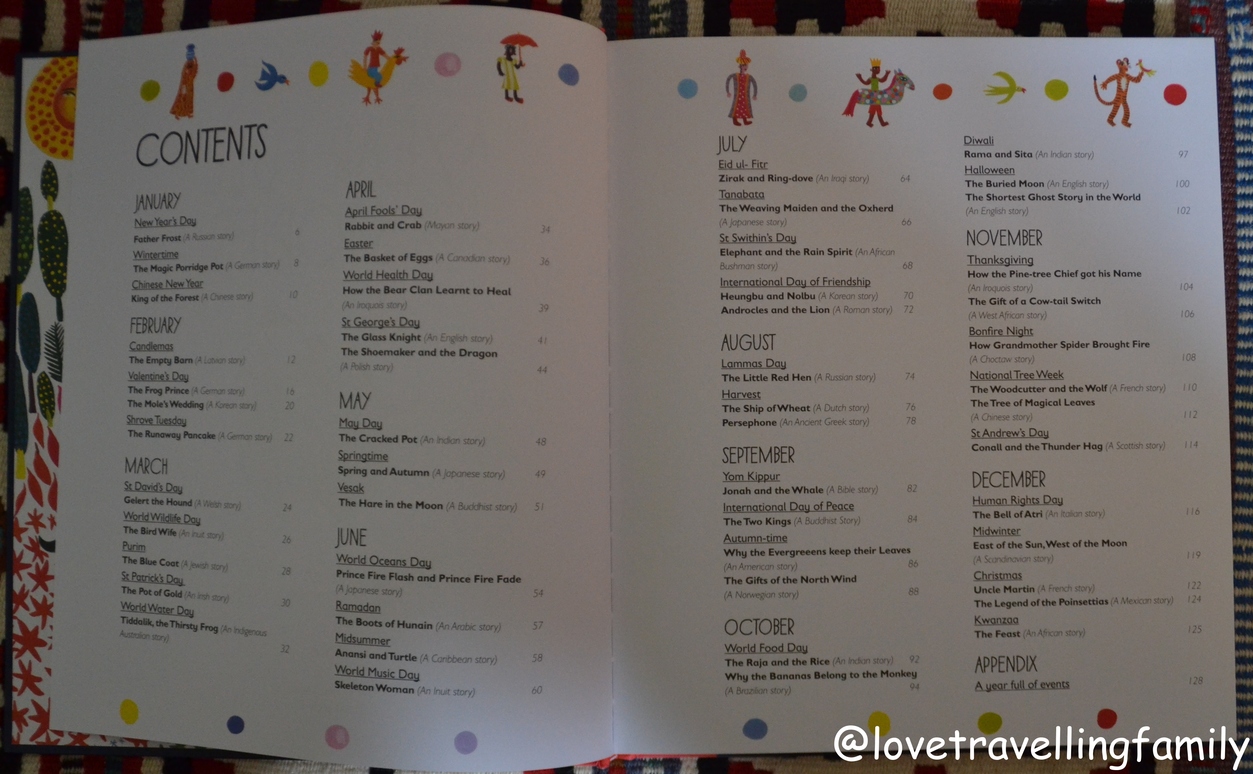
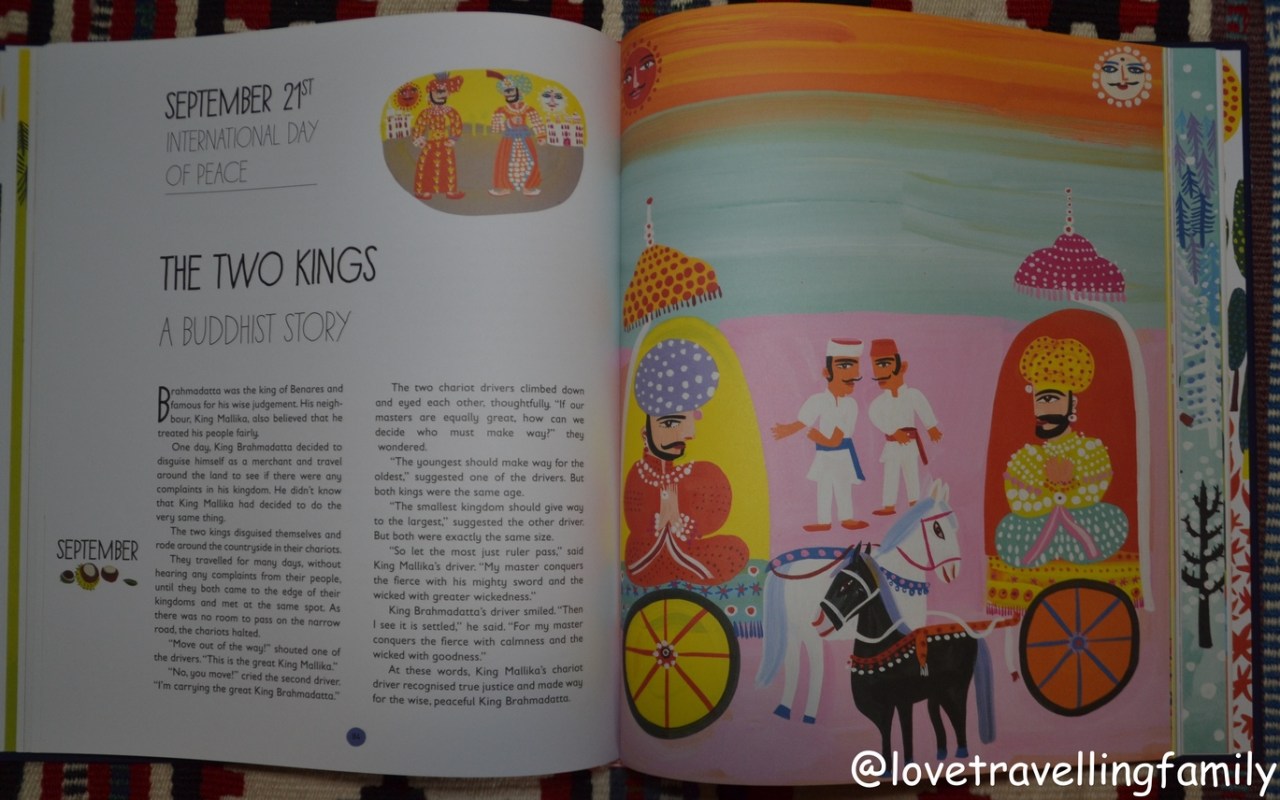
Angela McAllister collected and retold the tales, with illustrations by Christopher Corr. The book contains 52 stories organised through the months of the year. The publisher’s description and the photographed contents make the structure clear: it is a treasury to return to in small portions, rather than a single continuous tale. 6
The endpapers, contents and story spread reproduced in our photographs all belong to this one book. The artwork is the illustrator’s; the photographs are ours. They show why looking at the pages was part of what we enjoyed about the collection.
Choose for the child, then leave room to return
Our daughter’s age explains when we were reading these books together; it is not a universal age recommendation for all six. Compare the length, language, pictures and themes with your own child’s interests. A publisher’s age guide can help, but a preview or library copy can tell you more about how a particular book feels to read aloud.
What links the list is possibility. A girl can be a scientist, a colour can resist a jar and a folktale can make somewhere unfamiliar feel worth learning about. For a different memory of curiosity close to home, read our unexpected Munich celebration, where an ordinary walk became an afternoon we had not planned.
Good to know
A couple of useful questions
Are all three photographs of the same book?
Yes. They show the endpapers, contents and an illustrated spread from A Year Full of Stories. The illustrations are by Christopher Corr; they are not artwork created by our family. 6
Are these recommendations only for three-year-olds?
No. Three was our daughter’s age when the original review appeared. Preview each book for the child’s interests and readiness, particularly the serious themes in The Journey.
Does the Rebel Girls link describe the copy from 2017?
It links to a current revised-edition listing for comparison. The original review predates that edition, and the series contains several different books. Check the full title and edition. 1
Sources and useful links
For more context and practical details:
- Penguin Random House — current revised edition of Good Night Stories for Rebel Girls ↗
- ABRAMS — Ada Twist, Scientist, picture book ↗
- Flying Eye Books — Wild by Emily Hughes ↗
- Julia Denos — Swatch and its original book trailer ↗
- Flying Eye Books — The Journey by Francesca Sanna ↗
- Quarto — A Year Full of Stories, Angela McAllister and Christopher Corr ↗
Images and accounts are preserved from our original archive; the note above explains their context. Sources and planning links were checked on 18 October 2026.