Of all the traditions we have read about and talked through with our children, Día de los Muertos – the Day of the Dead – is the one that moved us most. It is a celebration of people who have died, held mainly from 31 October to 2 November, and it treats remembering as something warm and colourful rather than frightening.
This is how we explain it to children: what the days mean, what goes on an altar, why the skulls are smiling, how it differs from Halloween, and what our friend Arturo saw in Ocotepec, a village where families open their homes to visitors.
We have not celebrated Día de los Muertos in Mexico ourselves. This guide grew from our friend Arturo, who lives near Cuernavaca and shared his family's altar and a visit to Ocotepec with us, and from the way we talk about the festival with our own children at home.
What is the Day of the Dead?
Día de los Muertos is a Mexican festival for remembering family members and friends who have died. The idea is simple enough for a small child: for a short time each year, the people we miss are welcomed home, and the family prepares their favourite food, lights candles and tells stories about them.
The festival mixes Indigenous traditions with Catholic feasts that arrived with the Spanish in the sixteenth century. UNESCO added it to its list of the world's intangible cultural heritage in 2008, describing the brief return of departed relatives and the flowers, candles and food that guide them home. 1
- 31 October: final preparations of the altars
- 1 November: often for children (Día de los Angelitos) and All Saints' Day
- 2 November: for adults (All Souls' Day), with visits to the cemetery
How we explain it to our children
We tell our children that the Day of the Dead is a party for remembering. People are sad when someone dies, and they still miss them, but on these days they also laugh, cook, sing and share memories, as if the person had come back for a visit.
What we like most is that it lets children talk about death without fear. Death is part of everyone's life, just as life is. Having a day set aside for remembering, in a celebrating atmosphere, gives children words and pictures for something that adults often avoid. Even if your family has no link to Mexico, a photo of a grandparent and their favourite biscuit on a shelf can start the same conversation.
The ofrenda: what goes on a Day of the Dead altar
The heart of the festival is the ofrenda, a home altar for the people being remembered. Families decorate it with photographs, candles, papel picado (cut-paper banners), sugar skulls and the person's favourite food and drinks. Bright orange marigolds, called cempasúchil, are scattered as petals to make a path that guides the souls home. 1
Arturo, a good friend of ours from Mexico, shared photographs of the altar his family built in 2018, and they showed us how personal every ofrenda is. Building a small ofrenda together is the best way to explain the festival to children, because every object has a reason they can understand.
- Photographs of the people being remembered
- Candles to light the way
- Marigold petals and flowers
- Pan de muerto (sweet ‘bread of the dead’) and favourite foods
- Water and drinks for the journey
- Sugar skulls and papel picado
Sugar skulls, calaveras and face painting
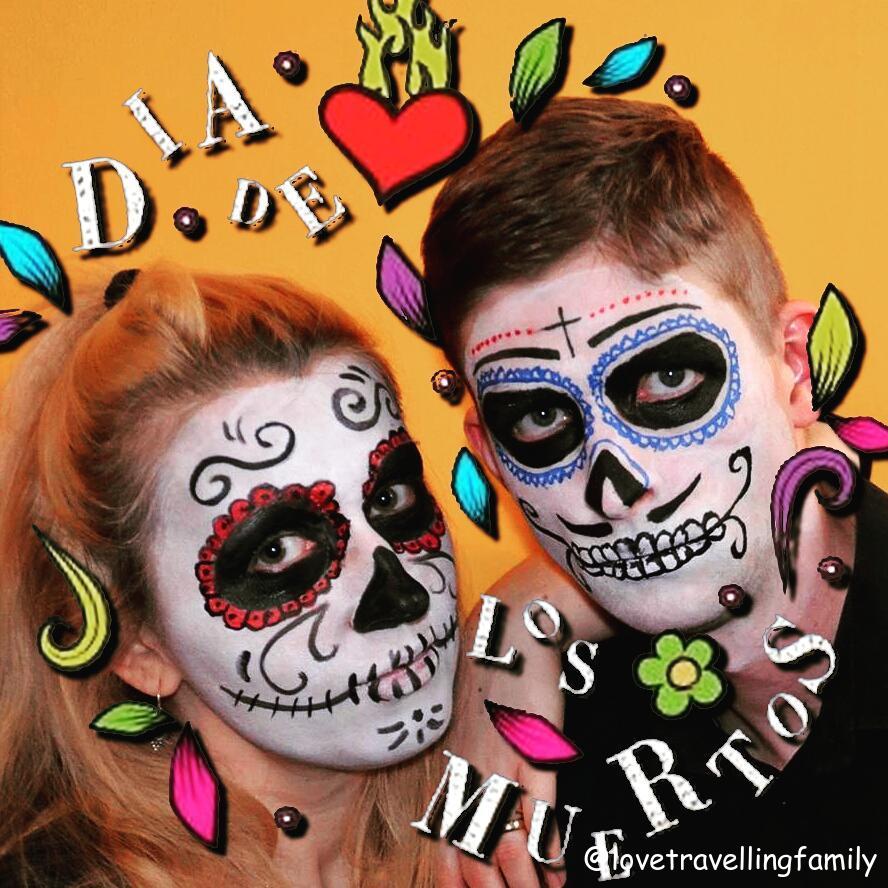
Skulls – calaveras in Spanish – are everywhere during Día de los Muertos: in sugar, in bread, on clothes, on masks and painted on faces. For children it helps to say that these skulls are not meant to be scary. They smile, they wear flowers, and they remind everyone that we all share the same ending, so we might as well remember people with joy.
Face painting is one of the easiest ways to join in from home. Our own photo above shows the sugar-skull face paint we did ourselves. Children love choosing their colours and flower shapes; use skin-safe face paints and keep the designs cheerful.
Day of the Dead vs Halloween: what's the difference?
Children often ask whether the Day of the Dead is Mexican Halloween. The dates overlap, and both grew from the same Christian calendar: Halloween is All Hallows' Eve, the night before All Saints' Day on 1 November. But the feeling is different.
Halloween is mostly about costumes, spooky fun and trick-or-treating. Día de los Muertos is about real people – grandparents, friends, sometimes a child – and about keeping their memory alive. In Mexico children do dress up as little skeletons (calaveritas) and go from house to house, but in many places this playfully represents the dead visiting to eat and drink with their families.
Ocotepec: the village where families open their doors
Ocotepec is a village on the edge of Cuernavaca in the state of Morelos, around fifteen minutes' drive from the city centre. Arturo's family went there for the Day of the Dead and came back with photographs that left us speechless. 3
Families who lost someone during the past year build an ofrenda nueva, a ‘new offering’. The person is recreated on the altar, dressed in their own clothes and shoes, with a sugar skull in place of the head and their favourite dishes around them. A path of flowers runs from the altar to the street to show that the house is expecting a soul. 2
Visitors are welcome. The custom is called la cereada: you bring a candle (cera) in honour of the person who died, place it on the altar, and the family offers you food and drink – perhaps pan de muerto, tamales or atole. As Arturo put it to us, it is as if you were the dead, walking from altar to altar and eating what is offered. 2 3
- Bring a candle for each house you enter
- Look at the altar quietly before anything else
- Accept what is offered, even a small taste
- Ask before taking photographs inside a family's home
- Dress modestly; this is a family's mourning as well as a celebration
Seeing it in Mexico City in 2026
If you are in Mexico City this year, the big Day of the Dead parade is planned for Saturday 31 October 2026 from 14:00, running along Paseo de la Reforma from the Diana Cazadora roundabout to the Zócalo. It is crowded, so arrive early with children and check the city's announcements about road closures. 4 5
For a quieter experience, the community traditions around Cuernavaca and in smaller towns show the private, family side of the festival that the parade cannot.
Books and films to explain it to kids
The Pixar film Coco (2017) is the easiest introduction for children: Miguel's journey to the Land of the Dead covers the ofrenda, marigold petals, the photo on the altar and the idea that people live on as long as they are remembered. In our original 2018 post we also shared a Coco picture book, which works well as a bedtime follow-up.
For more books we have read together, see our children's books for curious readers.
Good to know
A couple of useful questions
How do you explain the Day of the Dead to kids?
Call it a party for remembering. Families believe their loved ones come home for a short visit, so they make an altar with photos, candles, flowers and favourite food, and they share happy memories. It shows children that missing someone and celebrating them can happen together.
When is the Day of the Dead?
Mainly from 31 October to 2 November. 1 November is often dedicated to children who have died and 2 November to adults, though customs vary from region to region. 1
Is the Day of the Dead the same as Halloween?
No. Both fall at the start of November, but Halloween is mostly costumes and spooky fun, while Día de los Muertos honours real family members who have died, with altars, food and visits to the cemetery.
Why are there skulls if it is not scary?
The calaveras – sugar skulls, painted faces and skeleton figures – are smiling and decorated with flowers. They are a cheerful reminder that death is part of life, not something to hide from.
Sources and useful links
References for the practical information in this article:
- UNESCO — Indigenous festivity dedicated to the dead (Mexico), Representative List 2008 ↗
- adn40 — Ocotepec, Cuernavaca: families open their homes on Día de Muertos (9 October 2026) ↗
- Ideal Spanish Mexico — Ocotepec's Día de Muertos ‘La Cereada’ visitor notes ↗
- Récord — Mexico City Day of the Dead parade 2026: date and route ↗
- Mexico City tourism — Día de Muertos in Mexico City ↗
Information checked on 25 October 2026.